
Touch-less car wash systems have strong appeal on paper: no brushes, no physical contact with the vehicle, and a clear selling point for customers who worry about paint scratches or damage. Whether that appeal translates into the right choice for your specific site depends on a more complete picture — one that includes chemistry costs, wash quality trade-offs, and which customer population you’re serving.
Here’s an honest evaluation of how touch-less technology actually works, where it delivers, and what to look for when you’re evaluating touch-less car wash equipment for sale.
How a Touch-less Car Wash System Cleans Without Physical Contact
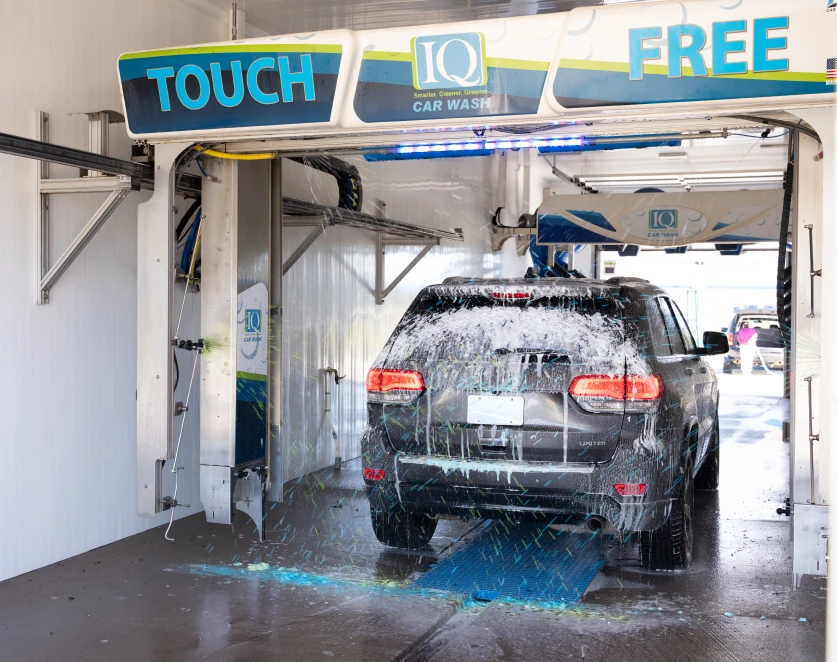
A touch-less car wash system cleans entirely through the combined action of high-pressure water and chemical chemistry. There are no brushes, no foam pads, and no physical friction against the vehicle surface. The wash relies on per-soak chemistry to break down and loosen contaminants, followed by high-pressure water jets to physically remove them.
The mechanics are straightforward: a gantry moves over and around the stationary vehicle, applying chemistry in the per-soak stage, allowing appropriate dwell time, then delivering pressurized rinse water to clear the loosened material. A spot-free final rinse — typically reverse osmosis or deionized water — finishes the cycle.
Because touch-less systems do all the work with water and chemistry alone, both need to be doing their jobs at a high level. Pressure matters. Chemistry concentration and formulation matter. Dwell time matters. Any weakness in the chemistry program shows up directly in wash quality — there’s no mechanical action to compensate.
Touch-less vs. Friction: Real-World Performance and Chemical Trade-Offs
The central trade-off between touch-less and friction-based car washing is this: friction systems use physical contact to loosen and remove contaminants, which generally requires less chemical strength to achieve a comparable level of clean. Touch-less systems compensate for the absence of friction with more aggressive chemistry.
In practice, this means touch-less operations typically run higher chemical cost per vehicle wash than soft-touch or hybrid systems. The exact differential depends on chemistry formulation, local water quality, and what soil load your typical vehicle presents — but it’s a real cost that needs to be in your per-vehicle economics.
On wash quality, touch-less can absolutely deliver a clean, presentable vehicle — particularly under normal soil conditions with properly formulated chemistry and well-maintained equipment. What it doesn’t do as effectively as friction is handle heavy soil loads: road grime, traffic film, bug accumulation. High-friction periods or markets with heavy road salt use during winter months may see wash quality variance that customers notice.
The flip side: customers concerned about paint, ceramic coatings, or the condition of a detailed or high-value vehicle are often specifically seeking touch-less. If your customer base skews toward higher-end vehicles or customers who are attentive to surface care, touch-less can be a strong market positioning play.
What to Look for in Touch-less Car Wash Equipment Before You Buy
When you’re evaluating touch-less car wash equipment, the specification conversation goes beyond the basic machine.
Chemistry system design. A touch-less system is only as good as the chemistry program it runs. Ask manufacturers how the equipment manages chemical delivery: automated dosing, concentration monitoring, and adjustment capabilities matter significantly for maintaining consistent wash results without constant operator intervention.
Pressure delivery and nozzle design. High-pressure water is doing the physical cleaning work. Pressure ratings, nozzle geometry, and the pattern of coverage across the vehicle profile all affect how effectively the system cleans a variety of vehicle shapes.
Vehicle profiling and sensing. A touch-less car wash system that adjusts its pass and nozzle positioning based on the vehicle’s actual dimensions delivers better coverage than one running a fixed program. This is especially important for a customer base with mixed vehicle types.
Water quality and reclaim. Touch-less systems are more sensitive to water quality than friction systems because the rinse is doing critical work. If your water supply has high mineral content, a reverse osmosis or deionized water system for the final rinse is important. Factor that into your total equipment and operating budget.
Parts availability and service support. This is true for any car wash purchase, but worth reiterating here. When you’re evaluating touch-less car wash equipment for sale, the vendor’s support model and parts availability matter as much as the equipment specification. A touch-less system that goes down on a busy weekend and can’t get a service response costs you real money.
Evaluating Touch-less Car Wash Systems for Sale: Price, Support, and Fit
Touch-less car wash systems for sale vary widely in price based on manufacturer, technology level, and included features. A basic touch-less in-bay system starts significantly lower than a fully featured unit with advanced vehicle profiling, automated chemistry management, and an integrated payment and loyalty platform.
The right question is never just “what does it cost?” — it’s “what is the total cost to operate this system, and what does the support look like when I need it?”
An inexpensive touch-less machine that runs through chemistry inefficiently, requires frequent service calls, or lacks support from a manufacturer with deep parts availability will cost you more over five years than a higher-quality system purchased from a manufacturer who has been building and supporting touch-less car wash equipment for decades.
D&S Car Wash Supply offers touch-less options under the IQ platform built around consistent performance, proven chemistry systems, and full manufacturer support from a team that’s been doing this for over 50 years. If you’re working through the touch-less-versus-friction decision for your site, or evaluating specific systems, we’re the conversation worth having before you finalize anything.