
If you’ve decided you want an automatic car wash system — as opposed to self-serve — the next layer of decisions is about which type of automatic system fits your site, your volume, and your operational model. The category covers a wider range of equipment than most first-time buyers expect.
This is a guide to what operators evaluating automatic car washing systems actually need to understand before they commit capital: format differences, performance benchmarks, and the features that matter most for long-term profitability.
In-Bay vs. Drive-Through Car Wash Equipment: Which Format Fits Your Site?
Two fundamentally different formats fall under the automatic car wash umbrella.
In-bay automatic systems operate with the vehicle stationary in a single bay while the wash equipment moves. The machine tracks over and around the vehicle, applying chemistry and water pressure or friction brushes in sequence. In-bay systems are compact, lower in capital cost, and straightforward to integrate into an existing fuel or retail site. They’re the most common format for convenience store programs and smaller standalone locations. An in-bay automatic car wash machine with a well-matched site can generate strong returns on modest volume.
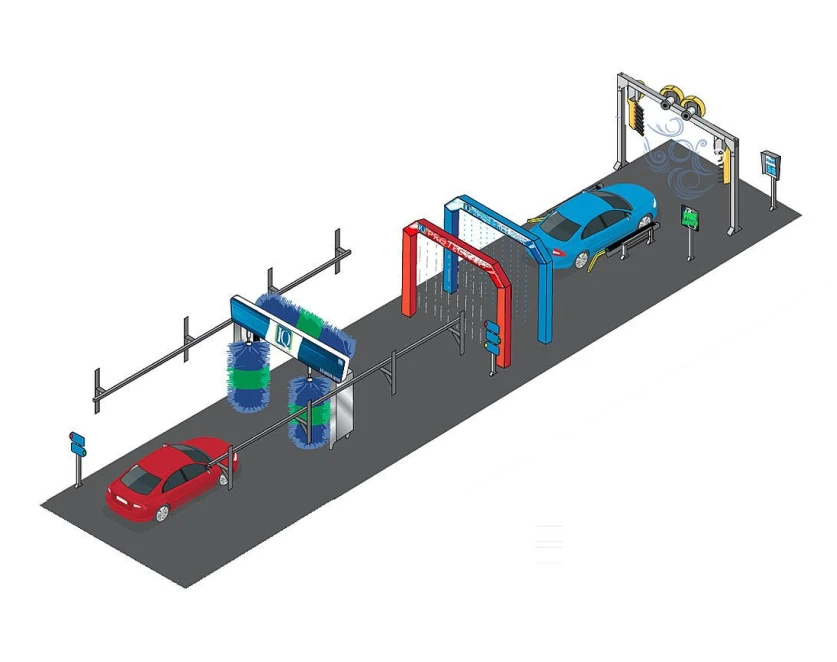
Drive-through car wash equipment — conveyor or tunnel systems — moves the vehicle through a fixed wash line. The customer drives onto a conveyor, shifts to neutral, and the vehicle travels through a series of wash stages: per-soak, main wash, rinse, spot-free rinse, drying. This format is optimized for throughput. A well-run express tunnel can process significantly more vehicles per hour than an in-bay system, but it requires more land, more capital, and more staffing.
The format decision should be driven by your traffic volume projections and your site dimensions. Trying to run a tunnel-level volume through an in-bay, or spending tunnel capital on a low-volume site, both lead to the same problem: a car wash that doesn’t pencil out.
How an Automatic Car Wash Machine Performs Under Real Operating Conditions
Manufacturer specifications tell you what a machine can do under optimal conditions. Real operating conditions introduce variables that specs don’t always account for.
Throughput. A rated throughput of 15–20 vehicles per hour on an in-bay is achievable, but only if customer arrival patterns support it. Gaps between vehicles, payment processing time, and vehicle positioning all affect actual VPH in operation. The spec is a ceiling, not a guarantee.
Wash quality consistency. This is where vehicle sensing technology matters. An automatic car wash machine that adjusts its pass based on the vehicle’s actual profile — length, height, protrusions, body curves — delivers more consistent coverage than one that runs the same program regardless of what’s in the bay. D&S IQ platform uses 3D vehicle mapping to address this directly: the system reads each vehicle and adjusts coverage accordingly. The result is better wash quality across a mixed vehicle population, which matters more than most buyers initially realize.
Chemical performance. Chemistry is doing real work in every wash cycle. Detergent concentration, per-soak dwell time, and rinse accuracy all affect the finished result. Inconsistent chemistry delivery shows up as inconsistent wash results and, over time, as customer complaints and churn.
Up-time. The most important performance metric for any operator is what percentage of your scheduled hours the machine is actually running. A car wash automatic system that delivers 95% up-time generates meaningfully more revenue over a year than one running at 88%.
Key Features to Compare Across Automatic Car Washing Systems
When you’re comparing car washing systems across manufacturers, these are the features worth spending time on:
Vehicle sensing and profiling. How does the system detect and adapt to different vehicle shapes? This affects wash coverage quality and the range of vehicles the machine can safely and effectively handle.
Chemistry management. Automated dosing versus manual adjustment. Automated systems reduce variability and chemical waste. Manual systems require more operator attention and introduce more opportunity for inconsistency.
Drive system and mechanical components. The mechanics of how the gantry moves or how brushes are driven directly affects maintenance frequency and longevity. Ask manufacturers about typical service intervals for drive components.
Control system and diagnostics. Modern car wash systems provide diagnostic data — cycle counts, error codes, maintenance alerts. A system with a capable control platform makes troubleshooting faster and more accurate, which reduces downtime.
Payment integration. Standalone payment terminal or integrated into a broader point-of-sale and loyalty platform? WashCard solutions integrate payment with loyalty programs in a way that consistently increases revenue per customer over time.
What “Car Wash Automatic” Actually Means for Day-to-Day Operations
An automatic car wash system reduces labor requirements significantly compared to a hand wash or self-serve operation — but it’s not zero-effort. Day-to-day operations involve chemical replenishment, visual inspection of wear components, payment system management, and periodic maintenance of mechanical systems.
The right automatic system minimizes that daily workload with reliable mechanics, accessible service points, and a control system that surfaces issues before they become failures. What you don’t want is a machine that requires daily calibration adjustments or has wear components that need replacement every few hundred cycles.
Before you commit to a system, ask the manufacturer what a typical operator spends per week on routine maintenance tasks, and what the most common service call is. The answers tell you more than the spec sheet.
D&S has been engineering and supporting automatic car wash systems under the IQ platform for over 50 years. If you’re evaluating systems for a new location or upgrading an existing one, we’re set up to walk through your specific site conditions and volume projections to help you identify the right format and configuration. That’s the conversation worth having before you finalize anything.