
The first real decision in evaluating commercial car wash equipment isn’t which brand to buy — it’s which format fits your site, your traffic volume, and your operating model. Get the format wrong and no amount of feature-set can make up for a machine that’s either undersized for your volume or over-engineered for your location.
This overview covers how the main commercial equipment types differ, what car wash machinery specifications actually tell you about real performance, and how to match the right format to your specific situation.
The Main Types of Commercial Car Wash Equipment
There are three primary formats in commercial car wash operation:
In-bay automatic. The vehicle pulls into a single bay and stays stationary while the equipment moves around it. This format is the workhorse of convenience store car wash programs, gas stations, and standalone sites with moderate traffic volumes. In-bay systems are available in touch-less and soft-touch configurations. They require a relatively compact footprint compared to tunnel systems and can often be integrated into an existing building or canopy structure.
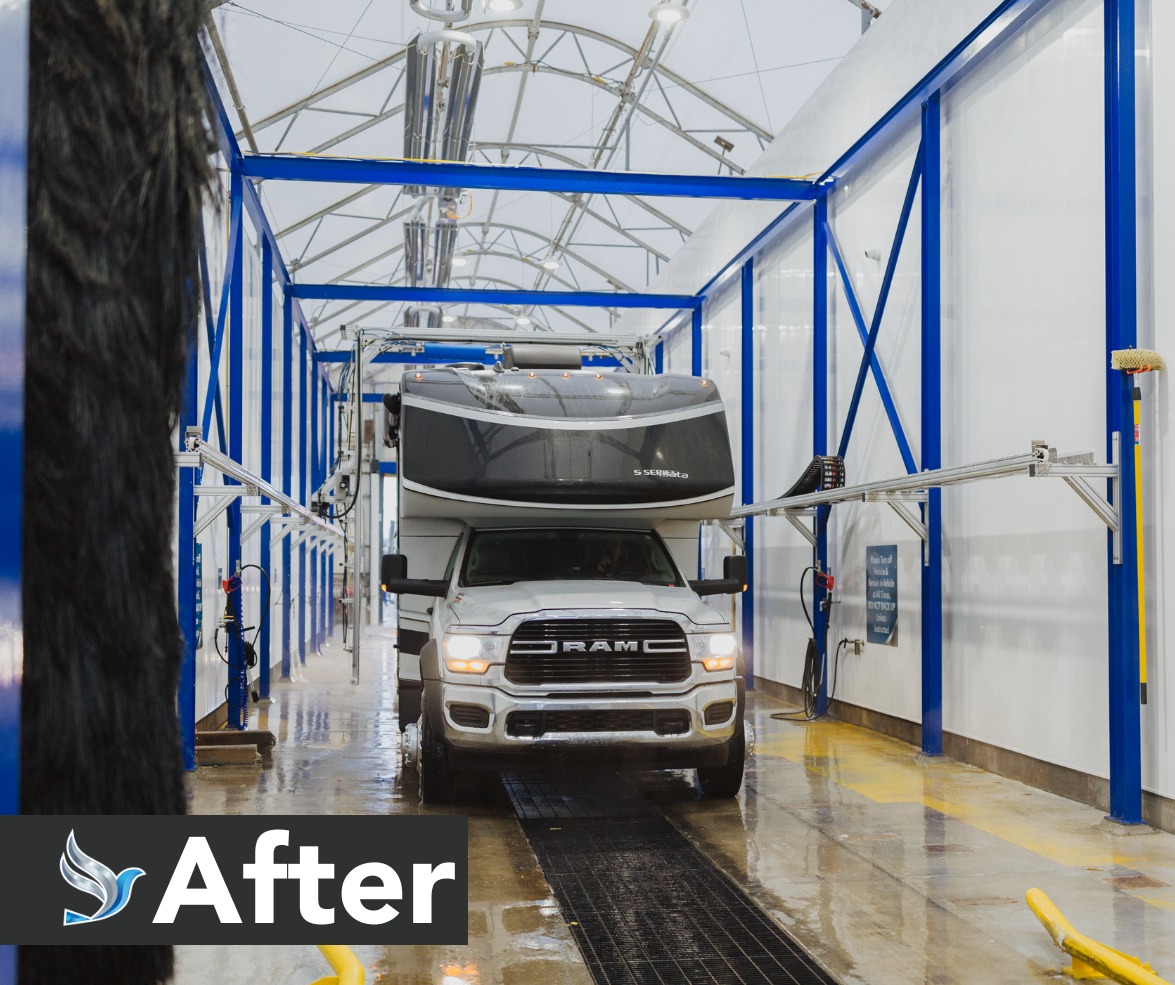
Tunnel (conveyor) systems. The vehicle is carried through a fixed line of wash equipment on a conveyor. Tunnels are built for volume — high-throughput express wash operations where speed and vehicle count per hour are the primary metrics. They require significantly more footprint, more capital investment, and more operational staffing than in-bay systems, but the throughput ceiling is much higher.
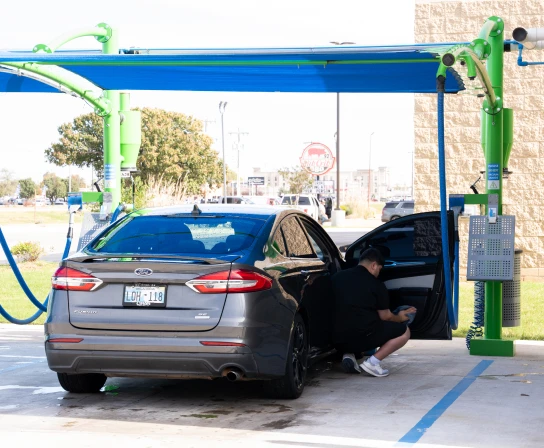
Self-serve. The operator provides the equipment and infrastructure; the customer does the washing. Self-serve car wash systems offer lower labor costs, passive income potential, and flexibility in bay count. They’re particularly well-suited to operators who want a low-overhead revenue stream alongside a fuel station or retail location.
The right format for your site depends on traffic volume, available footprint, staffing model, and whether you want a full-service or hands-off operation.
What Car Wash Machinery Specifications Tell You About Performance
Car wash machinery specs are only useful if you know how to read them against your actual operating conditions.
Vehicles per hour (VPH) is the most cited throughput metric. For an in-bay automatic, a practical VPH rating in the 12–20 range is common depending on cycle time and feature set. A tunnel system might achieve 80–120+ VPH at full throughput. The number only matters in the context of your actual or expected customer volume — a 20 VPH machine is more than adequate for many convenience store programs.
Cycle time is the flip side of VPH. Shorter cycles mean higher throughput, but there’s a point at which rushing a cycle trades off wash quality. The right balance depends on your market positioning: are you competing on speed and volume, or on wash quality and customer experience?
Chemical injection accuracy affects both wash quality and operating cost. Precise metering means less chemical waste and more consistent results vehicle to vehicle. Ask manufacturers for specifics on how their system manages chemistry delivery — vague answers here are worth noting.
Up time metrics and maintenance intervals tell you how much of the time your auto wash equipment is actually generating revenue versus sitting down. Evaluate these alongside the manufacturer’s service model.
In-Bay vs. Tunnel: Matching Auto Wash Equipment to Your Traffic Volume
For most investors adding a car wash to an existing convenience store, fuel site, or smaller standalone location, an in-bay automatic is the right starting point. The capital requirement is lower, the site preparation is more straightforward, and the operational overhead is minimal.
If you’re building a dedicated express wash operation and you’re projecting consistent volume of 200–400+ vehicles per day, a tunnel system’s throughput capacity starts to justify the higher capital investment.
The answer isn’t always obvious from volume projections alone. Your peak-hour concentration matters. If you’re expecting 200 vehicles per day but 80 of them arrive in a two-hour window, an in-bay system may create bottlenecks and customer frustration. A site with similar daily volume but more even distribution can handle in-bay efficiently.
Work through your traffic projections with realistic peak-hour estimates before deciding on format.
How Car wash Systems Are Priced and What Drives the Final Number
Car wash systems aren’t priced on a simple per-unit model. The final cost of a commercial car wash installation reflects:
Equipment package. What’s included in the base system, and what’s optional? Chemical systems, dryers, payment terminals, and signage packages may or may not be bundled.
Installation and site prep. Concrete work, plumbing, electrical, trenching for utility runs, and any structural modifications to an existing building all add to the project cost. These costs vary significantly by site.
Technology and payment systems. A basic car wash machine with coin-drop payment is at one end of the range. An in-bay system with a full-featured point-of-sale terminal, license plate recognition, and loyalty program integration is at the other. That technology adds real revenue capability — WashCard solutions, for example, consistently increase average ticket size and drive repeat visits.
Manufacturer support model. Some manufacturers bundle training, startup chemicals, and initial service contracts into the price. Others strip those out and offer them as add-ons. The difference matters for both budgeting and for what your first six months of operation actually looks like.
D&S Car Wash Supply has been helping operators evaluate, specify, and install commercial car wash equipment for over 50 years. If you’re working through a site evaluation or trying to match a format to your location, we’re set up to walk through that conversation with you — from first concept to opening day.