
The RV and large vehicle segment is growing — and most wash operators aren’t equipped to serve it. Here’s what it actually takes.
________________________________________
The recreational vehicle market has seen sustained growth over the past several years. Millions of RVs are on the road in North America, and that number continues to climb. Add commercial trucks, buses, and heavy equipment to the picture, and you have a large, underserved segment of vehicle owners who need regular washing and have very few good options for getting it done.
That gap is an opportunity — but only for operators with the right equipment, the right site configuration, and a realistic understanding of what large vehicle washing involves. Operators who try to serve this segment with equipment designed for passenger vehicles end up with poor wash results, frustrated customers, and equipment wear they didn’t plan for.
This post is a practical guide to what RV and large vehicle washing actually requires — the vehicle dimensions, the cleaning challenges, the equipment considerations, and the business case for getting it right.
________________________________________
Who Are Your Customers?
Before getting into equipment, it helps to understand the large vehicle customer base — because it’s more diverse than it first appears, and different customer types have different needs and willingness to pay.
RV owners — Class A, B, and C motorhomes range from about 21 feet to 45 feet in length and up to 13 feet in height. RV owners are typically highly engaged with their vehicles and willing to pay a premium for a wash that actually cleans the full unit without damaging it. They travel frequently, often on long routes, and they actively seek out wash facilities capable of accommodating their vehicle. A well-located RV wash with strong online visibility can draw customers from a wide geographic area.
Commercial truck operators — Independent owner-operators and small fleet trucks stopping at truck stops, travel centers, or standalone wash facilities. These customers need a functional, efficient wash — not necessarily premium — and they value speed and reliability. A truck that’s in the wash bay is not moving freight.
Municipal and government fleets — Transit buses, fire apparatus, utility vehicles, and public works equipment. Fleet wash contracts with municipalities or transit authorities are a recurring revenue opportunity for operators with the right equipment and capacity.
Buses and coaches — Charter buses, school buses, and shuttle coaches. Similar dimensional requirements to Class A RVs, often managed by fleet operators who want a consistent, reliable wash solution.
Oversized personal vehicles — Full-size pickup trucks with lift kits, large SUVs, and towed trailers. These customers are often turned away by standard car wash equipment and actively look for facilities that can accommodate them.
Understanding which customer types your location is positioned to serve — based on your geography, traffic patterns, and proximity to campgrounds, truck routes, or fleet facilities — should drive your equipment and site decisions.
________________________________________
The Dimensional Reality of Large Vehicles
This is where the gap between standard car wash equipment and large vehicle requirements becomes concrete. Standard in-bay automatic systems are engineered around a passenger vehicle envelope of roughly 7–8 feet tall and 18–20 feet long.
Here’s what you’re actually working with in the large vehicle segment:
Vehicle Type Typical Height Typical Length
Class A Motorhome 11–13 ft 25–45 ft
Class C Motorhome 10–12 ft 21–35 ft
Class 8 Semi Truck (cab only) 13–14 ft 20–25 ft
Transit Bus 11–13 ft 35–45 ft
School Bus 10–12 ft 35–40 ft
Full-size Pickup (lifted) 7–9 ft 18–22 ft
The height gap alone eliminates most standard in-bay equipment. A system topped out at 8 feet simply cannot wash a 12-foot Class A motorhome — there’s no configuration or adjustment that bridges that gap. It requires a system built with large vehicle clearances from the ground up.
Length creates a different challenge. Longer vehicles require either extended wash systems designed to cover the full vehicle length or multiple pass cycles — both of which require purpose-built equipment and thoughtful bay design.
Width and geometry add complexity on top of height and length. Large vehicles have mirrors, slide-outs, external storage compartments, running boards, and chassis components that extend beyond the basic body profile. Wash systems need to reach these surfaces — and do so without contact that causes damage — which requires engineering specifically designed for large vehicle geometry.
________________________________________
What Standard Equipment Gets Wrong
Operators who attempt large vehicle washing with standard in-bay equipment encounter predictable problems:
Clearance failures — Equipment that physically cannot accommodate the vehicle height. A customer who pulls into a bay and discovers the wash arch is too low has wasted a trip. That customer posts about the experience online and doesn’t return.
Incomplete coverage — A wash arch sized for a passenger car doesn’t cover the roof of a motorhome, the top of a semi cab, or the full sidewall height of a bus. The customer pays for a wash and gets a partial result. This generates complaints, refund requests, and negative reviews.
Damage risk — Standard equipment operating near its height limits creates risk of contact with vehicle rooftop equipment — antennas, vents, air conditioning units, solar panels — that weren’t accounted for in the system design. An RV owner whose rooftop unit is damaged by a wash system is a significant liability exposure.
Equipment wear — Large, heavy vehicles put different mechanical loads on wash equipment than passenger cars. Equipment not rated for these loads wears faster, breaks more frequently, and costs more to maintain.
Chemical underperformance — The soil loads on large vehicles are different in type and volume from passenger car contamination. A chemical program calibrated for passenger car washing underperforms on road film, diesel exhaust residue, and the heavy surface contamination that accumulates on vehicles covering thousands of miles.
________________________________________
What Purpose-Built Large Vehicle Washing Looks Like
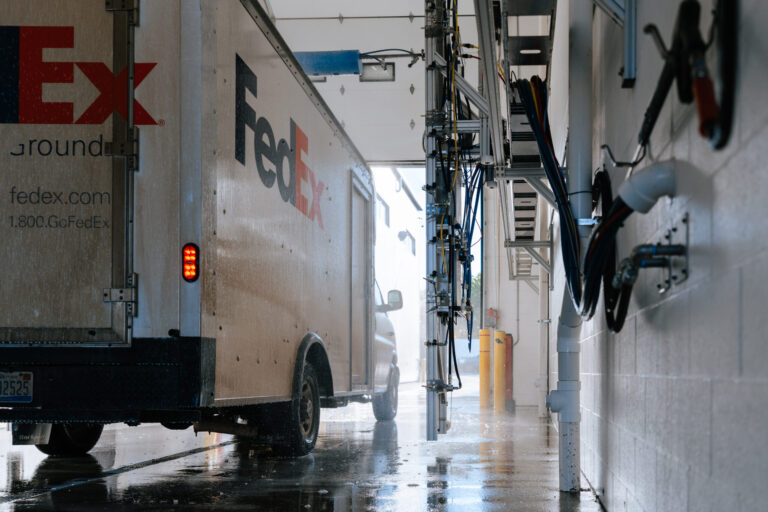
A purpose-built large vehicle wash system is engineered around the actual dimensions and operating requirements of the vehicles it’s designed to wash — not adapted from a smaller platform.
The key design elements that distinguish a purpose-built system:
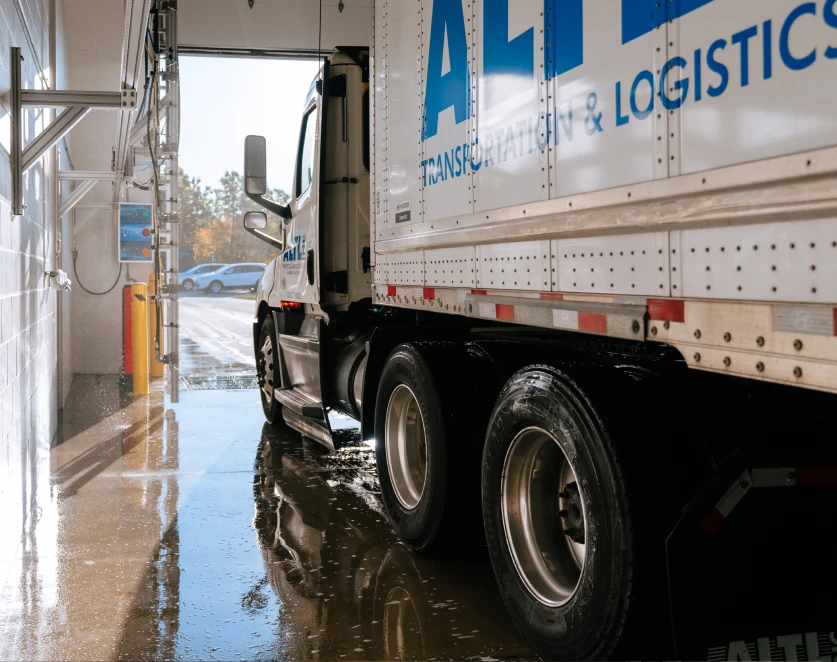
Clearance architecture — Full-height clearance of 14+ feet that accommodates Class A motorhomes, semi cabs, and transit buses without modification or risk. This isn’t a standard system with a taller arch bolted on — it’s a system whose entire geometry is designed around large vehicle dimensions.
Extended reach wash components — Brushes, spray arches, and wash heads positioned and sized to cover the full surface area of a large vehicle — including roof, full sidewall height, and the complex geometry of mirrors, fairings, and external fixtures.
3D vehicle mapping — Advanced systems profile each vehicle as it enters and dynamically adjust wash component positions and sequences based on actual vehicle dimensions. This means the system handles a Class C motorhome, a transit bus, and a Class A motorhome in the same bay without manual reconfiguration — and without the conservative clearance margins that static systems require. The result is better coverage and faster cycle times across a mixed vehicle fleet.
Underbody and chassis cleaning — Large vehicles accumulate significant road contamination on their undercarriage and chassis. A complete large vehicle wash program includes underbody spray systems that address these surfaces — not just the visible exterior.
Chemistry matched to large vehicle soils — Detergents, degreasers, and rinse aids formulated for the heavy soil loads, large surface areas, and specific surface types (gel coat, aluminum, painted steel, rubber) found on large vehicles.
Structural capacity — Bay construction and equipment mounting rated for the weight, height, and clearance requirements of large vehicle operation.
________________________________________
Site and Bay Design Considerations
Equipment capability is only part of the equation. The physical site needs to accommodate large vehicles from entry to exit.
Bay dimensions — A purpose-built large vehicle bay typically requires a minimum clear width of 14–16 feet and a clear height of 14–15 feet at the wash arch. Bay length needs to accommodate your target vehicle types with safe approach and exit clearances.
Approach and exit geometry — Semi trucks, motorhomes, and buses have turning radii significantly larger than passenger vehicles. Tight corners, narrow entrances, and low-clearance overhangs at the site entry eliminate customers before they ever reach the bay. Drive your site in a rented or borrowed large vehicle before finalizing your design — what looks spacious on a site plan can feel very different from the cab of a Class A motorhome.
Stacking and queuing space — Large vehicles are long. A 40-foot motorhome in your queue takes the physical space of two or three passenger cars. Design your stacking lane accordingly.
Signage and wayfinding — Large vehicle operators are actively evaluating whether a facility can accommodate their vehicle before they commit to pulling in. Clear, visible signage stating your vehicle height and length capacity — and confirming that large vehicles are welcome — is a meaningful conversion factor. An operator who posts their clearances on Google Business Profile and their approach signage captures customers who would otherwise drive past with uncertainty.
________________________________________
The Business Case
The large vehicle wash market is genuinely underserved in most markets. The customer has a vehicle that needs washing regularly, limited good options for getting it done, and a demonstrated willingness to travel for a facility that works. That’s a favorable supply-demand position for a well-equipped operator.
Pricing power — Large vehicle washes command meaningfully higher prices than passenger car washes. A quality RV wash in a well-located facility typically prices at $30–$75 depending on vehicle size and wash package. Commercial truck washes run $20–$50 per unit. Compared to a $10–$15 passenger car wash, the revenue per vehicle is substantially higher.
Lower volume requirement — The higher revenue per wash means you need fewer vehicles to generate the same revenue as a high-volume passenger car operation. A large vehicle bay doing 8–12 washes per day at $40–$60 per wash generates $320–$720 in daily revenue — comparable to a busy passenger car bay at much lower transaction volume.
Recurring fleet revenue — Municipal fleet contracts, transit authority agreements, and commercial fleet accounts provide predictable, recurring revenue. A single fleet contract can represent meaningful committed volume that stabilizes your revenue base.
Competitive differentiation — In most markets, the number of facilities capable of washing a Class A motorhome or a transit bus can be counted on one hand. Being one of those facilities is a durable competitive position — not easily replicated by a competitor installing standard car wash equipment.
________________________________________
What to Evaluate Before You Invest
If you’re considering adding large vehicle washing capability — either as a new build or an addition to an existing site — work through these questions before committing capital:
• What is your target customer mix? RV owners, commercial trucks, municipal fleets, and buses have different needs, volumes, and pricing expectations. Clarity on your primary customer type drives equipment specification.
• What large vehicle traffic exists in your trade area? Proximity to major RV routes, campgrounds, truck stops, and municipal facilities is a strong indicator of demand. Traffic counts alone don’t tell the story for large vehicle washing — you need to understand the specific vehicle types moving through your area.
• What does your site allow? Can your lot accommodate the approach geometry, bay dimensions, and stacking space that large vehicles require? This is often the binding constraint.
• Who will support your equipment? Large vehicle wash systems are more complex than standard in-bay equipment. Your supplier’s service capability — response time, parts availability, technician expertise — matters more here than in a standard passenger car installation.
________________________________________
The Bottom Line
RV and large vehicle washing is one of the more compelling opportunities in the car wash industry for operators willing to invest in the right equipment and site configuration. The customer need is real, the segment is underserved, the revenue per vehicle is high, and the competitive position of a well-equipped facility is durable.
The path to capturing that opportunity runs through purpose-built equipment — systems engineered for large vehicle dimensions, not adapted from a passenger car baseline. The IQ MAX from D&S Car Wash Supply is the first automated wash system built from the ground up specifically for commercial trucks, buses, RVs, and heavy equipment. If you’re evaluating large vehicle washing for your operation, it’s the right place to start.
________________________________________
D&S Car Wash Supply manufactures the IQ MAX — the only automated wash system engineered from the ground up for large vehicles. If you’re evaluating large vehicle wash capability for a new build or an existing site, contact us to talk through what the right setup looks like for your location and target customer