
Standard car wash equipment wasn’t built for your vehicles. The Truck Wash Is.
________________________________________
If you operate a truck stop, a commercial fleet, or a municipal vehicle operation, you’ve probably run into this problem: the car wash equipment that works well for passenger vehicles simply doesn’t cut it when the vehicle is 13 feet tall, 70 feet long, and weighs 80,000 pounds loaded.
It’s not a sizing issue you can paper over with a wider bay or a taller arch. The differences between washing a passenger car and washing a Class 8 truck run deeper than dimensions — and operators who try to make standard equipment work for large vehicles end up with three predictable outcomes: poor wash quality, frequent equipment damage, and frustrated drivers who stop using the wash altogether.
This post breaks down what’s actually different about large vehicle washing, what a purpose-built system looks like, and why getting this right matters to your bottom line.
________________________________________
The Problem With Standard Car Wash Equipment on Large Vehicles
Most in-bay automatic systems and tunnel washes are engineered around a vehicle envelope of roughly 7–8 feet tall and 20 feet long. That covers the vast majority of consumer vehicles and light trucks — which is exactly what those systems were designed for.
Commercial trucks, buses, RVs, and heavy equipment operate in an entirely different envelope:
• Height: Class 8 trucks typically run 13–14 feet. Many buses and RVs exceed 12 feet. Standard equipment tops out well below this.
• Length: A semi with a 53-foot trailer stretches the physical limits of most wash bays and conveyor systems.
• Width: Commercial vehicles are wider, with more complex geometry — mirrors, fairings, fuel tanks, step rails — that standard brushes and spray arches aren’t positioned to reach.
• Weight: 80,000 lbs loaded changes the requirements for floor structure, approach angles, and conveyor systems entirely.
• Surface complexity: Commercial trucks have undercarriages, wheel wells, and chassis components that accumulate road grime, salt, and corrosive material in ways a standard rinse arch won’t address.
Forcing large vehicles through equipment not designed for them doesn’t just produce a poor wash — it creates clearance issues, equipment wear, and potential damage to both the vehicle and the wash system.
________________________________________
What Truck Stops Actually Need From a Wash System
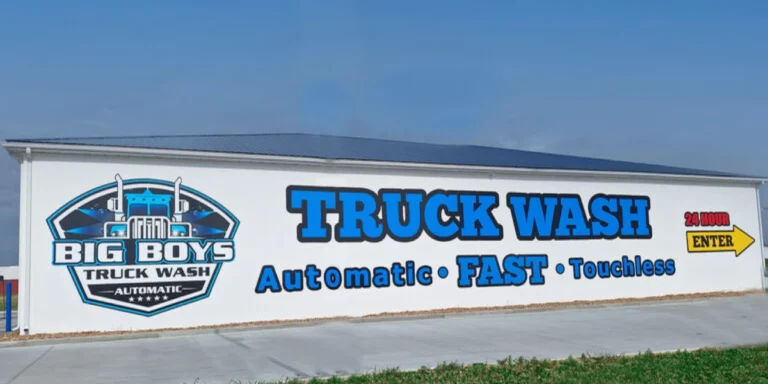
For a truck stop, a wash system is a revenue-generating amenity that influences driver behavior. Drivers talk. Fleet managers evaluate stops based on what’s available. A wash that works — that’s fast, effective, and sized correctly — becomes a reason to pull in. One that doesn’t becomes a reason to pass.
Here’s what the operation actually requires:
Throughput That Keeps Up With Traffic
A busy truck stop sees significant vehicle turnover. Your wash system needs to process vehicles efficiently enough that a driver pulling in during a peak period isn’t staring at a 45-minute queue. Purpose-built large vehicle systems are engineered for throughput — not just the ability to wash one truck, but to wash trucks consistently, at volume, with minimal downtime between cycles.
A Wash That Covers the Whole Vehicle
Truck drivers care whether the cab is clean — but fleet managers care whether the entire unit is clean. Road salt, diesel exhaust particulate, and highway grime accumulate across the full length of a trailer, the under carriage, and the chassis. A system that only effectively cleans the cab and upper surfaces is leaving the job half done.
Purpose-built large vehicle systems use extended reach components, underbody spray systems, and wash profiles engineered to address the full vehicle — not just the parts that fit within a standard passenger-car envelope.
Reliability Under Heavy Use
A wash system at a busy truck stop runs hard. Equipment that works fine at consumer car wash volumes may degrade quickly under the load, vehicle weight, and physical demands of large vehicle washing. Purpose-built systems are built to the durability and service life requirements of commercial operation — not adapted from a lighter-duty design.
Chemical Performance on Heavy-Duty Soils
The contamination on a commercial truck is different from what accumulates on a passenger vehicle. Road film, diesel exhaust, agricultural residue, and heavy mud require chemistry and application systems matched to the soil load. A chemical program designed for consumer car washing underperforms on commercial vehicles — leaving films, streaks, and residue that reflect poorly on the wash and frustrate drivers.
________________________________________
What Fleet Operations Need From a Wash System
For a corporate fleet, a municipal fleet, or a transportation company, the calculus is different from a truck stop — but the conclusion is similar.
Corrosion Prevention Is a Maintenance Line Item
Salt, road chemicals, and moisture accumulate in wheel wells, frame rails, and undercarriage components. Regular washing isn’t just about appearance — it’s a corrosion management practice that extends vehicle service life and reduces maintenance costs. A system that doesn’t effectively clean the undercarriage isn’t doing the job that fleet managers actually need done.
For municipal fleets — fire apparatus, transit buses, utility vehicles — this is particularly important. These vehicles represent significant capital investment and long service lives. The economics of corrosion prevention over a 15–20 year asset life are straightforward.
Consistent Results Across a Mixed Fleet
Fleet operations rarely run a single vehicle type. A municipal fleet might include transit buses, light-duty service vehicles, pickup trucks, and heavy equipment. A commercial fleet might mix Class 8 tractors, box trucks, and vans. A capable wash system needs to handle that range without requiring manual intervention or producing inconsistent results across vehicle types.
Speed and Scheduling
Fleets operate on schedules. Wash time is downtime. A system that takes 20 minutes per vehicle when you have 40 vehicles to turn around before the next shift creates a real operational problem. Purpose-built large vehicle systems are designed with fleet cycle times in mind.
________________________________________
What a Purpose-Built Large Vehicle Wash System Looks Like
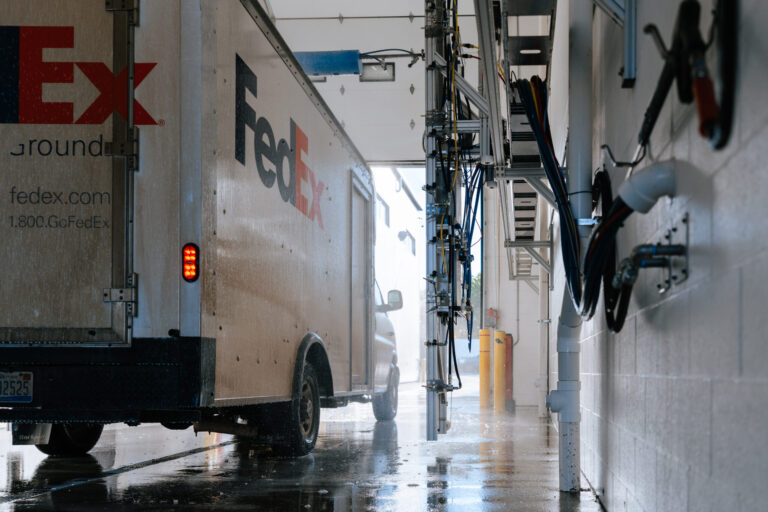
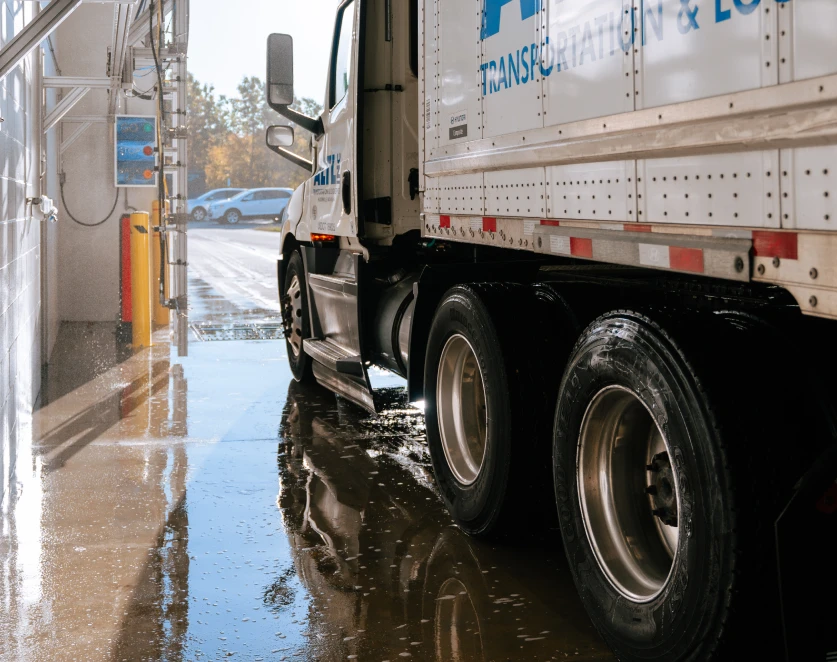
The IQ MAX from D&S Car Wash Supply is the first automated wash system engineered from the ground up specifically for commercial trucks, buses, RVs, and heavy equipment — not adapted from a passenger car platform.
The distinction matters because purpose-built means:
• Clearances and geometry designed around actual large vehicle dimensions — not extended from a passenger car baseline
• 3D vehicle mapping technology that profiles each vehicle as it enters and adjusts wash components dynamically — so the system handles a pickup truck, a transit bus, and a Class 8 tractor in the same bay without manual reconfiguration
• Undercarriage and chassis cleaning built into the wash profile, not added as an afterthought
• Throughput engineered for commercial volume — the system is designed to process vehicles efficiently at the pace a busy truck stop or fleet operation demands
• Durability specs matched to heavy use — built for the weight, the cycle counts, and the soil loads of commercial vehicle operation
The result is a wash that actually cleans commercial vehicles — fully, consistently, and at the throughput rates that make it a workable part of a truck stop operation or fleet maintenance program.
________________________________________
The Business Case
For truck stop operators: a capable large vehicle wash generates direct revenue per wash, increases dwell time and spend across other amenities, and builds driver loyalty that translates to repeat visits. Operators who invest in a system that works for their vehicles see utilization rates that justify the investment. Operators who install marginal equipment see it sit idle.
For fleet operators: the ROI calculation runs through vehicle longevity, reduced maintenance costs, and labor savings relative to manual washing. A system that can wash 10 vehicles per hour with one operator versus hand-washing at 2–3 vehicles per hour with multiple people is a straightforward operational win.
In both cases, the cost of getting this wrong — buying equipment that doesn’t perform, replacing it prematurely, or losing the revenue opportunity entirely — typically exceeds the cost of getting it right the first time.
________________________________________
The Bottom Line
Truck stops and fleet operations aren’t edge cases in the car wash industry — they’re a distinct segment with distinct requirements. Standard equipment wasn’t designed for this application, and the gaps show up in wash quality, equipment wear, and operator frustration.
If you’re evaluating wash systems for a truck stop, a commercial fleet, or a mixed-vehicle operation, the right starting point is a system engineered for the actual vehicles you’re washing — not one adapted from a smaller-vehicle platform.
________________________________________
D&S Car Wash Supply manufactures the IQ MAX — the only automated wash system built from the ground up for commercial trucks, buses, RVs, and heavy equipment. If you’re evaluating options for your truck stop or fleet operation, contact us to talk through what the right system looks like for your site and vehicle mix.